
If you're wondering what the best trees to plant in Nashville are, then you're in the right place.
In this blog post, I'll discuss how to pick the right tree for your yard or garden as a Nashville homeowner.
My name is Tanner Smith, and I'm an arborist and tree care professional with over 15 years of experience in the industry.
A lot of planting mistakes come from people choosing the fastest grower or the cheapest flowering tree, or whatever looks good at the nursery.
Instead, you should first think about WHERE you are going to plant the tree.
It doesn't matter whether you live in East Nashville, Sylvan Park, or Green Hills. It all comes down to examining the area where you'll plant the tree and then decide.
Start with the spot, not the species
Before you plant a tree, there are five important things to consider:
- How much room the tree is going to take up when it's at full size (think far ahead)
- How much sun the intended planting area is getting
- The soil condition and whether it stays wet after the rain
- How close the tree will be to your house, driveway, power lines, or any other buildings or structures
- How much space the root system of the tree is going to take up underground if whether it might conflict with buried utilities like pipes, sewer lines, or cables.
Of course, there is more to consider.
But these five tips provide a very good starting point.
If in doubt, I would recommend getting in touch with a professional tree planting service to be sure you're making the right decision for your lot or garden.
Good choices for many Nashville yards
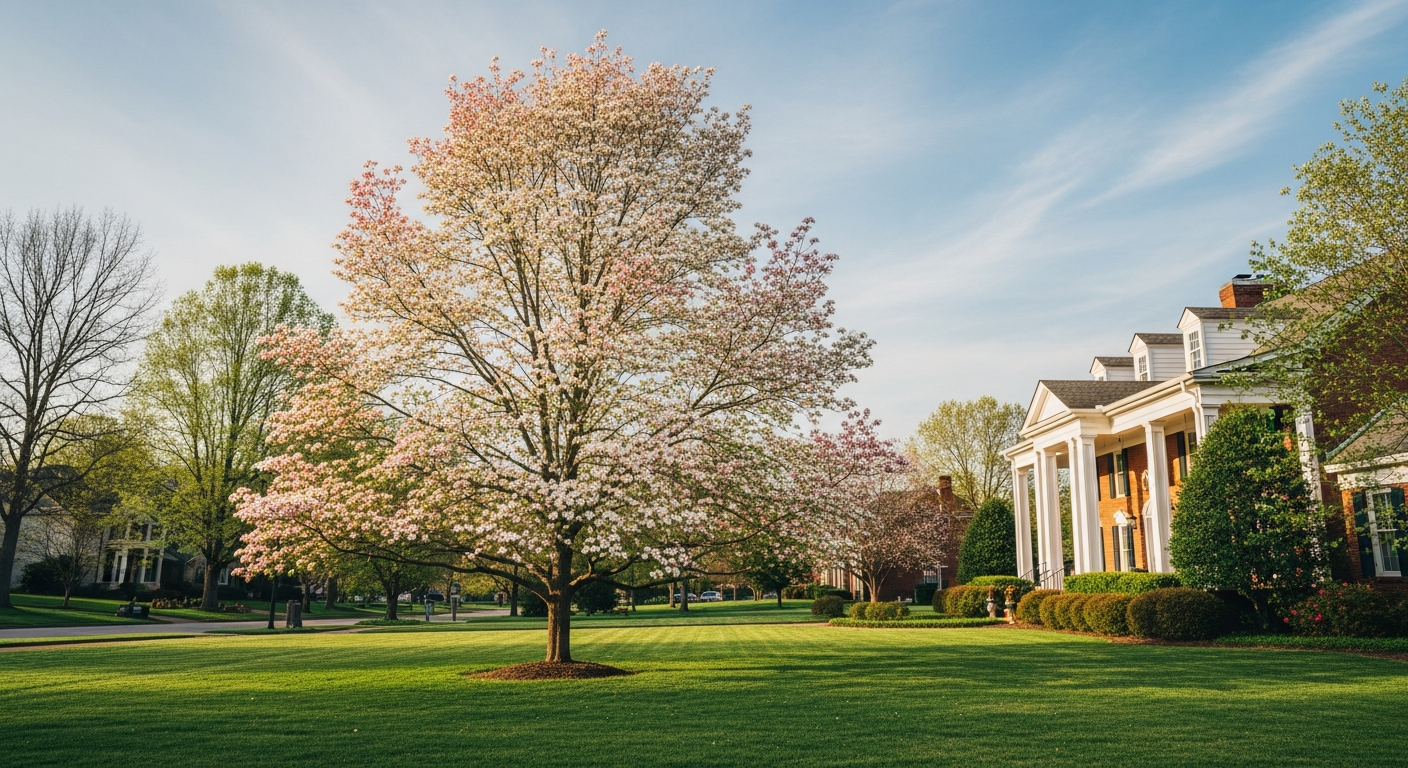
For a smaller front yard or planting bed, flowering dogwood, eastern redbud, and serviceberry are usually good choices that fit better than fast-growing shade trees like silver maple, tulip poplar, or sycamore.
These smaller trees usually fit better near homes. They also bring spring colors and make more sense for older neighborhoods where the space is often a bit more limited.
If you want to take a closer look at one of my personal local favorites, check out our guide to the flowering dogwood.
For bigger properties with real room to grow, trees like the tulip poplar, bald cypress, and well-placed oak species often make for a good long-term choice.
The tulip poplar is Tennessee's state tree and it can be found all over Middle Tennessee. But it's a big tree and needs a lot of space once it matures.
The bald cypress is a good choice for lower-lying areas that generally stay damp after heavy rainfalls.
Local oak trees, such as the white oak, northern red oak, or shumard oak, are strong long-term shade trees, given they're being planted far enough away from any structures and they're given space to properly develop.
Here's one practical rule I can give you:
If you're planting closer to your house or any other structures, go smaller.
Likewise, if you're planting out in the yard for future shade, you can definitely think bigger.
That might sound obvious, but I see it being ignored all the time, and then later people want the tree removed because the roots encroach on the foundations, or the branches are hanging over the roof. That can easily be avoided with a smart planting decision.
Further Resources For Specific Tree Species
If you want to go deep, here's a detailed list of tree species recommendations specifically for Nashville, put together by the City of Nashville.
Also, be sure to check out our in-depth tree guides for the most common local tree species in Nashville.
I recommend to check out both before you buy from a garden center or nursery.
Metro-listed species to avoid
In the tree species resource from the City that I've linked in the previous paragraph, you'll also find Metro Nashville's non-recommended list of trees to plant.
For your convenience, here it is (I've also added the actual reasons why these species should be avoided):
Non-Recommended Trees
| Common Name | Botanical Name | Why It's Not Recommended |
|---|---|---|
| Silver Maple | Acer saccharinum | Weak wood prone to storm breakage; aggressive surface roots that damage sidewalks and foundations. |
| Tree-of-Heaven | Ailanthus altissima | Highly invasive; suckers aggressively; foul-smelling and a host for the spotted lanternfly. |
| Minosa | Albizia julibrissin | Short-lived and weak-wooded; spreads invasively from seed; messy flowers and pods. |
| Paper Mulberry | Broussonetia papyrifera, syn. Morus papyrifera L | Aggressive root suckers; brittle wood; messy fruit drop. |
| Sugarberry | Celtis laevigata | Weak wood and frequent limb drop; messy fruit. |
| Hackberry | Celtis occidentalis | Brittle limbs; prone to galls and witches' broom; messy fruit. |
| Leyland Cypress | Cupressus x leylandii | Shallow roots fail in wind; highly susceptible to canker disease. |
| Russian Olive | Elaeagnus angustifolia | Invasive; thorny; outcompetes native vegetation. |
| Ash spp. (green, white, blue) | Fraxinus spp. | Almost certain death from emerald ash borer in this region. |
| Chinese Parasol Tree | Firmiana simplex | Invasive; weak wood; messy seed pods. |
| Goldenrain Tree | Koelreuteria paniculata | Self-seeds aggressively; weak wood; short-lived. |
| China Berry | Melia azedarach | Invasive; berries are toxic to humans and pets. |
| Royal Paulownia/Princess Tree | Paulownia tomentosa | Highly invasive; brittle, fast-growing wood that fails early. |
| White Poplar | Populus alba | Aggressive root suckers; weak wood; very difficult to remove once established. |
| Bradford Pear | Pyrus calleryana (all varieties) | Splits in storms; cross-pollinates into invasive Callery pear; foul-smelling flowers. |
| Pin Oak | Quercus palustris | Suffers chlorosis in Nashville's alkaline soils; declines and yellows over time. |
| Chinese Tallow | Triadica sebifera | Highly invasive; sap is toxic. |
| Eastern (Canadian) Hemlock | Tsuga canadensis | Devastated by hemlock woolly adelgid; struggles in Nashville's summer heat. |
| Siberian Elm | Ulmus pumila | Brittle wood prone to breakage; spreads invasively from seed. |
The list includes several trees that I am still seeing many homeowners get talked into planting.
Bradford pear is the big one.
It's most common across the Southeast and Mid-Atlantic, including Tennessee, North Carolina, South Carolina, and Georgia.
It was planted a lot in suburban developments from the 1980s-2000s. The reason is because it grows very fast, it flowers early, and it looks neat and "clean" in new neighborhoods.
The problem is that bradford pears are notorious for splitting when faced with strong winds and stormy weather.
Most locals seem to know that. Recently I even read one Nashville homeowner on a forum write "Please, no bradford pears."
I can only agree with him.
It's just not a smart and sustainable long-term choice for most residential properties in Nashville.
What about the other trees on the non-recommended list?
Well, some of them are weak wooded like the bradford pear. Some are invasive species. And others simply aren't aging well in the average residential setting here.
The problem is not just what they look like this year.
It's rather what they often tend to turn into after a few hot summers, strong winds and storms, or years of unchecked growth.
Think past planting day
I always tell homeowners that a good tree should be making sense ten or twenty years from now.
That means that you think about factors like the root space, branch spread, cleanup (are you prepared to remove leaves), and whether or not the species is potentially going to become a removal job later.
If you're already having a problem tree on your property, our article on signs it's time to remove a tree in Nashville can help you think through what to watch for and when to call an arborist.
In my experience, the best thing to do for most homeowners in Nashville is usually to plant a tree that fits the lot instead of trying to force your favorite one into the wrong place.
That generally leads to fewer problems down the road, and a healthier garden to enjoy for your friends and family over time.
Need help choosing the right tree?
If you want a second opinion before planting a new tree, or you need help with getting a poor species removed, Smith Works Tree Service and Land Management is here to support you.