
Most trees in Nashville should not be removed just because they look a little rough, might have dropped a few limbs, or maybe had a hard season.
Oftentimes, it's sufficient to get them properly pruned and to make sure they're not structurally impaired in a way that would make them a hazard.
That said, in some cases a tree absolutely should be removed, and it would be irresponsible to leave it standing.
My name is Tanner Smith, and I'm the owner of Smith Works Tree Service and Land Management here in Nashville.
I am consulting homeowners and businesses every week on their trees and whether removal is necessary or not.
And as much as I see unnecessary removals, I also see homeowners that are sometimes waiting too long to get a tree removed. Even though the tree is showing clear warning signs.
Once a tree fails, the cleanup, property damage risk, and associated safety risks are almost always greater than would it have been dealt with earlier.
In this article, I'm outlining the most common signs a tree should be removed. Also, I'll give some hints as to what you should be looking out for as a Nashville homeowner in the aftermath of Winter Storm Fern and how it has impacted trees. Specifically, what signs to look for to determine whether you should call an arborist for a tree risk assessment.
What Makes a Tree a Removal Candidate?
The decision whether to remove a tree or not is often highly debatable, even among arborists.
Preservation vs. Safety
Generally speaking, there are two camps: the preservation-minded, and the more safety-oriented arborists.
The preservation-minded arborists often call the more safety-oriented ones "take-'em-all-down" crews or refer to the bigger companies that specialize in removals "big arb".
And while it is an unfortunate truth that there are many companies that try to push removals only to put more money into their own pocket, not every "safety-over-preservation arborist" is automatically disingenious.
Likewise, the more safety-oriented arborists might easily accuse the preservation-minded ones of putting people's lives and their property at danger.
However, I don't see that argument made very often, because most preservation-first arborists are certified and well-educated. They usually have a good eye for when a tree actually does need to be removed for safety reasons.
Technically, the economical argument is somewhat flawed, as yearly maintenance pruning, when added up over time, will make an arborist more money than a one-time removal.
That's where you'll hear some arborists say things like, "Hey, I'll give you a good price if you'll make me your tree guy for life".
Certainly not the worst long-term business strategy.
Of course, most companies that push removals are out for the fast money and don't think long-term, so the argument is probably still a valid one in practice.
The 3 main factors that determine removal necessity
When we put the whole preservation vs. safety discussion aside for a second, we'll be able to appreciate that most arborists actually do agree on the following:
The right decision whether to remove a tree or not, comes down to 3 main factors.
- The condition of the tree
- The likelihood of failure
- What the tree could hit if it were to fail
As for the evaluation of these factors in practice, there's a lot of room for interpretation.
But there are still some widely agreed upon signs that strongly suggest removal as the better, and safer choice.
1. The Tree Is Dead or Clearly Dying
This is the most obvious sign.
A dead or rapidly declining tree is not going to recover its strength if you just give it "some time".
It won't happen.
In most cases, the best thing is to remove it sooner rather than later.
Common signs include:
- Large sections of the canopy that don't to produce leaves in season
- Brittle branches throughout the canopy
- Bark that's sloughing off in sheets
- Dead branches in the canopy
- Many limbs and branching that are dropping
Whether or not to remove a dead tree also depends a lot on the location, and whether it's close to your home or in another spot where it might be dangerous if you leave it standing.
If it's not in a spot where it might become problematic, it can often be left alone. Wild animals like birds and squirrels love snags and use them for roosting, food foraging, and nesting.
2. The Tree Recently Started Leaning
I'd like to emphasize that not every leaning tree needs to be removed.
On the contrary, many learning trees have grown with a natural lean for years and remain stable.
The real concern is a tree that just started to lean, especially if the lean has become stronger.
In these cases, removal is often something that needs to be done, or at least considered, depending on the specific circumstances.
Common signs of a dangerously leaning tree include:
- Soil heaving
- Cracking ground around the base
- Exposed roots
- A root plate that appears to be lifting
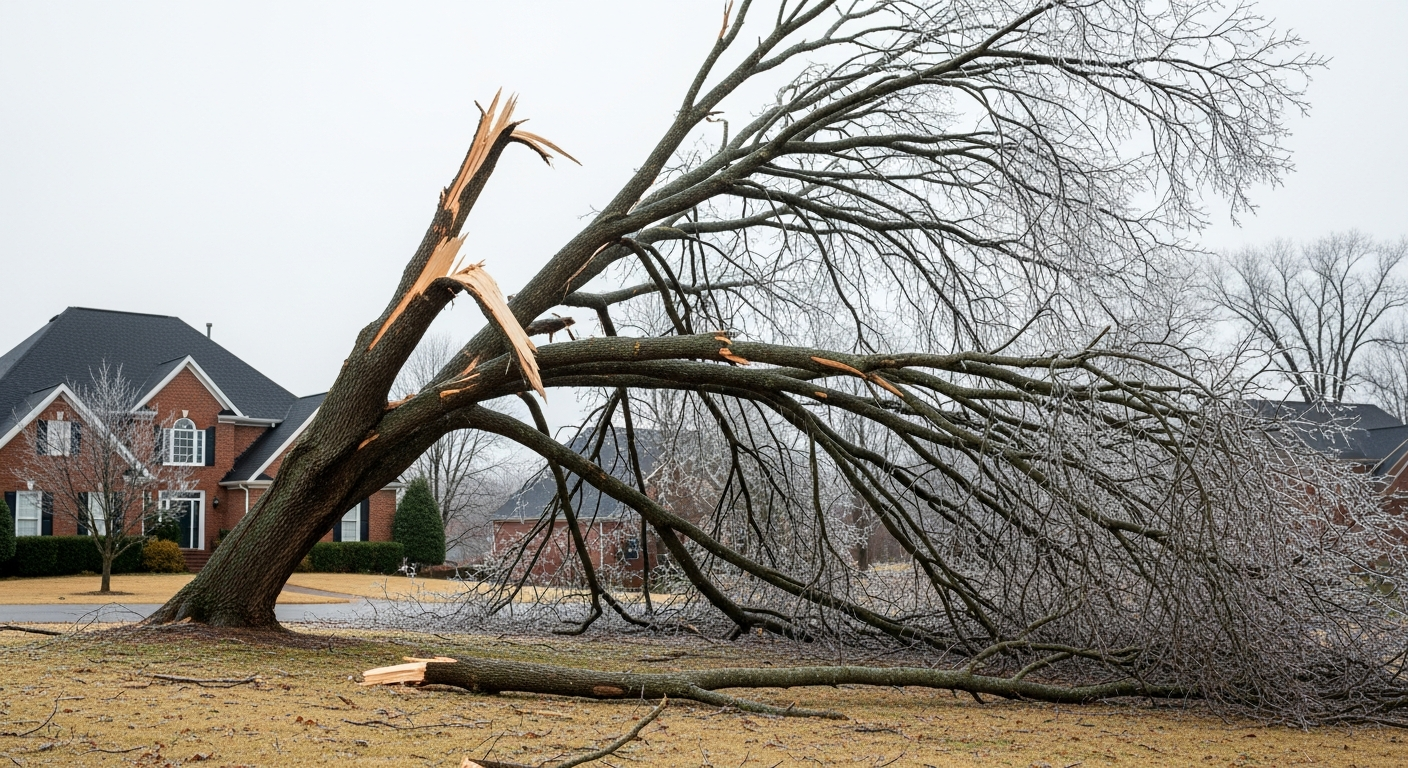
I've been seeing many trees recently in Nashville that have just started to lean and are showing these signs after Winter Storm Fern.
Many trees that stayed standing after the ice had melted away still ended up with structural or root issues that now cause them to start to lean and become unstable.
If in doubt, it's best to contact a professional tree removal service.
3. The Tree Has Major Cracks, Splits, or Weak Branch Unions
These are some of the strongest signs a tree might need to be removed:
- Visible cracks in the trunk of your tree
- Deep splits where major limbs are attached
- Co-dominant stems that are starting to pull apart
You should take these seriously, they are not mere "cosmetic problems".
They are important indicators of internal structural problems.
It doesn't matter if the tree looks otherwise green and alive, if it displays any of the above signs you should contact an arborist for a tree risk assessment.
4. The Tree Has Large Dead, Broken, or Hanging Limbs in the Canopy
A tree does not have to fail completely to be dangerous.
You might see limbs in the canopy which are:
- Dead
- Cracked
- Broken off and dangling
- Otherwise damaged
In and of itself, this does not warrant a full tree removal.
Often, those limbs can be addressed with professional tree trimming.
In other cases, the amount of damage or the position of the defect however can make a full tree removal the more responsible option.
5. The Base of the Tree Shows Decay, Cavities, or Fungal Growth
If you're seeing any of the following, you should have your tree inspected:
- Mushroom or fungal conks near the base
- Cavities, meaning large hollow areas in the tree trunk
- Rotten, brittle, or unusually soft wood at the base
- Major old wounds around the base
- A tree trunk that sounds hollow
- Other signs of a damaged or weakened base or trunk
None of these necessarily mean your tree can't be saved, but they often point to issues that are indicative of a tree that is dealing with severe health issues.
In my experience, the question is usually not just whether there's decay, but how much sound wood is left, where the defect is located, and what the tree could hit if it fails.
In any case, you should have it looked at.
6. The Tree Has Already Been Hit Hard by Recent Storms
After Fern, I've been seeing many trees that should urgently be inspected, but homeowners don't seem to recognize the danger that these trees present.
If a tree has lost major limbs, or had to deal with heavy ice loads and other storm-related strains, you shouldn't assume it's safe just because it's still standing upright.
During and after Fern, thousands of trees in Nashville tipped, splintered, and died.
Some of the most hazardous trees are the ones that stayed upright but now have hidden cracks, overloaded branch unions, or compromised roots.
If a tree on your property took obvious (or not so obvious) storm damage earlier this year, there is a good chance that it deserves a closer look. Ideally, before Nashville goes into its next stretch of strong spring and summer weather.
7. The Tree Could Hit a High-Value Target if It Fails
So far, I've mainly talked about the condition of the tree.
The condition mostly determines the likelihood of failure.
That leaves us with the third factor which determines the necessity of removal:
What the tree might hit if it were to fall.
If you have a tree with moderate, or even more severe issues, it might still be manageable for many years – IF it is standing in a wide open field with nothing nearby.
The same tree over a bedroom, garage, driveway, parked vehicles, fence line, neighbor's property, or public sidewalk becomes much harder to justify leaving in place.
This is especially important around utility lines.
Nashville Electric Service warns property owners not to attempt DIY tree work near overhead wires. According to their guidelines, trees within 15 feet of power lines must be assessed by an NES representative, while trees outside that range are generally the homeowner's responsibility.
You can read the full details here: https://www.nespower.com/electrical-safety/tree-trimming/
A Good Rule of Thumb for Nashville Homeowners
To summarize, you should have your tree evaluated soon if any of the following are true:
- Your tree is dead or rapidly declining
- Your tree has recently started leaning or the ground is moving at the base
- You're seeing major cracks, a split trunk, or weak branch unions
- Your tree has large limbs that are dead, broken, or hanging over your house
- The base of your tree is showing signs of decay, cavities, or fungal growth
- You're unsure whether your tree was damaged during Fern or other recent storms
- Your tree could hit your house, driveway, vehicles, fence, or power lines if it fails – and you haven't had it checked on since Fern