A dead or dying tree is one of the most common – and most overlooked – hazards on a Nashville property. Smith Works Tree Service provides professional hazard tree assessment and safe dead tree removal for homeowners and businesses across Middle Tennessee.
Licensed & Insured • Free Written Estimate • Upfront Pricing • Professional Arborist Knowledge
Get a Free Dead Tree Assessment
Decay and rot weaken wood fiber and root systems in ways that aren't always visible from the ground. A tree that looks intact can fail without warning – during a storm, on a calm day, or in the middle of the night.
Smith Works handles dead tree removal for both residential tree services and commercial tree services across Nashville and Middle Tennessee. The removal process for a dead tree often differs significantly from removing a healthy, standing tree. Dead wood is brittle, bark may be loose or completely detached, and the tree's structural integrity can't be assumed – all of which changes how rigging, sectional removal, and every individual cut is planned and executed. If the tree has already come down, see our fallen tree removal page instead.
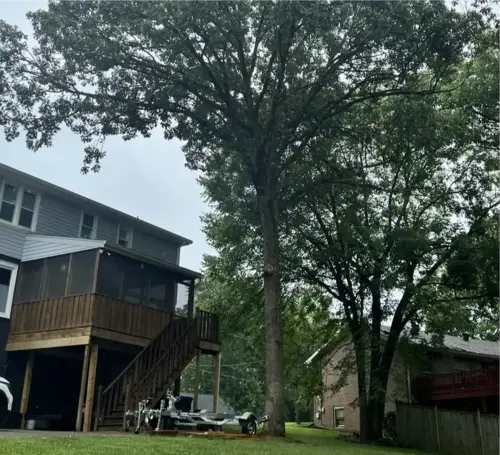 Hazard Tree
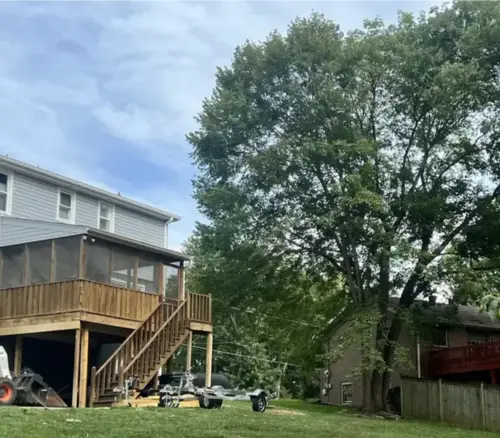 Cleared & Clean
These warning signs often indicate serious structural decline. When you notice one or more, a professional tree hazard assessment is the right next step.
Fungal conks (shelf mushrooms) growing on the trunk, soft or crumbling wood at the base, or mushrooms sprouting from the roots are signs of internal decay that chainsaw work alone can't fix. Internal rot can hollow out a tree while the outside still looks intact.
Internal cavities eliminate structural support. A hollow trunk may not be visible from the outside – it requires a trained inspection to assess. Trees with hollow trunks can collapse even without significant external force.
Soil lifting or buckling around the base of the tree is a sign of root failure or root rot. When the root system can no longer anchor the tree, it becomes unstable. Root heaving combined with any lean is a serious hazard indicator.
A new or worsening lean – especially when combined with root heaving or cracking soil – signals that the tree has already begun to shift. A tree that has moved once can move again, faster.
Co-dominant stems (two equally-sized trunks growing from one base) or vertical cracks in the trunk signal structural weakness. Bradford pear trees in particular are notorious for catastrophic branch failure as they age – dead or damaged Bradford pears are a common service call across Nashville.
Dead branches suspended in the canopy – sometimes called widowmaker limbs – are ready to drop under any load: wind, ice, or rain. They're among the most common hidden hazards on residential properties.
Isolated dead branches are common and can often be addressed with targeted deadwood removal as part of routine tree maintenance. When the majority of the canopy is dead or gone, full dead tree removal is typically the safer path.
Large sections of bark separating from the trunk, combined with a canopy that fails to leaf out in spring, are reliable indicators of tree death. Some evergreens may retain needles for a season after dying, masking the problem.
Only a tree hazard assessment by a trained arborist can determine with certainty whether a tree is truly dead or whether selective deadwood removal and tree maintenance could preserve it. If you're seeing any of these signs, the right first step is a professional on-site evaluation – not a wait-and-see approach.
Every dead tree removal job is different. Here are the situations our crew handles most often – each requiring a specific approach to keep your property and family safe.
Metro Nashville requires a Notification of Tree Removal permit for trees on private property meeting certain size thresholds – see nashville.gov for current requirements. For trees that have already begun to fail, an Emergency Tree Authorization Form is also available through the city. Nashville also maintains the Root Nashville urban tree inventory and works with the Nashville Tree Conservation Corps – homeowners who need to replace a removed tree can explore those programs for replacement planting support. Smith Works can advise on whether your specific removal requires a permit before any work begins.
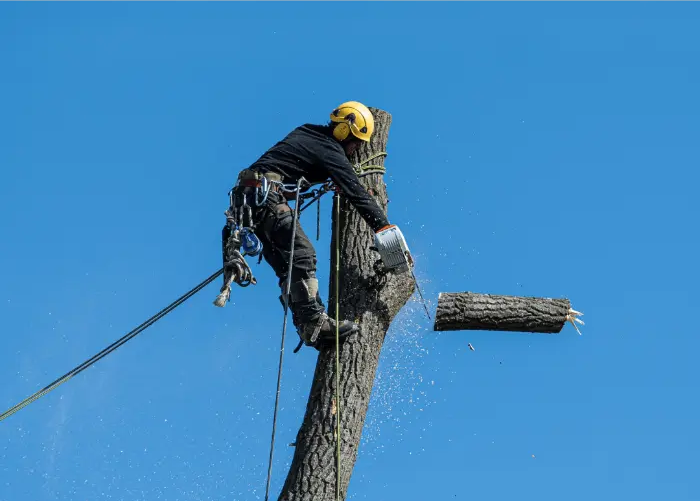
Full sectional removal from the top down when the tree can't be safely felled in one piece. Controlled lowering with rigging keeps every section in a planned drop zone, protecting your lawn, gardens, fences, and adjacent structures from uncontrolled impacts.
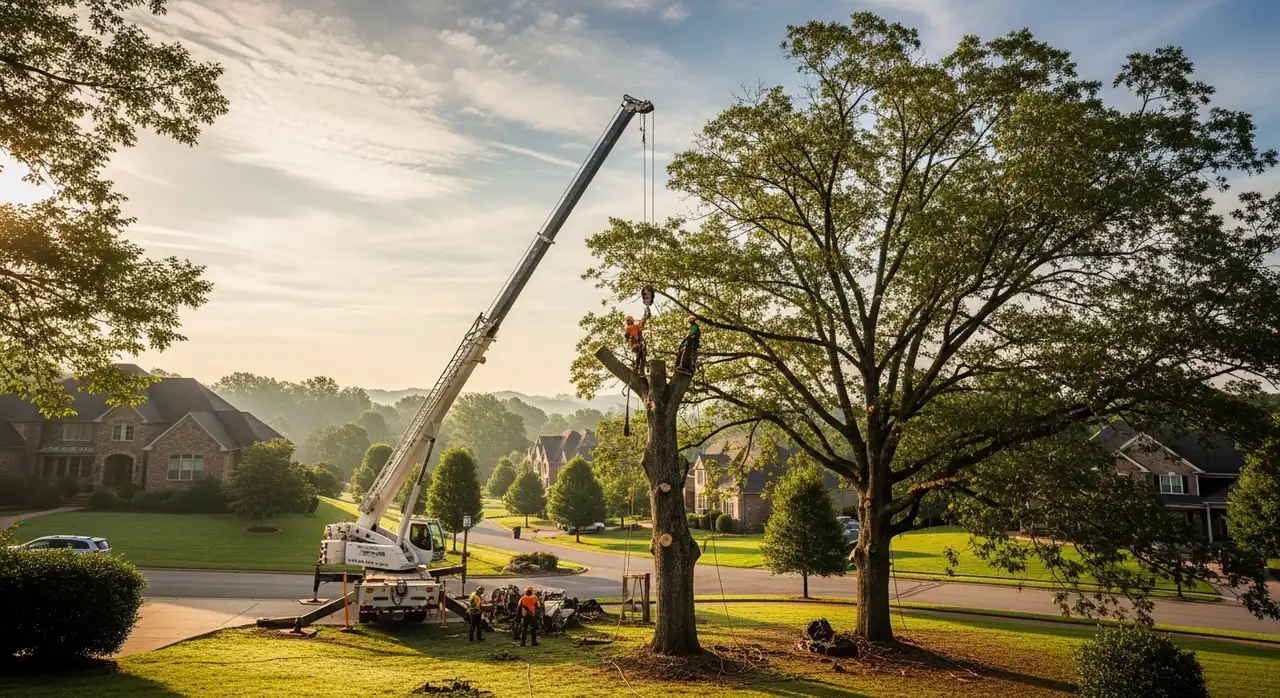
Trees over houses, near fences, or close to overhead power lines require crane removal or bucket truck access and careful exclusion zone planning for jobsite safety. We coordinate utility coordination as needed and assess the right equipment for the job before work begins.
A tree that has already begun to shift requires careful assessment before any cutting begins. Sectional removal from the top down, combined with strategic rigging and controlled lowering, protects the surrounding property when working on trees with compromised root systems.
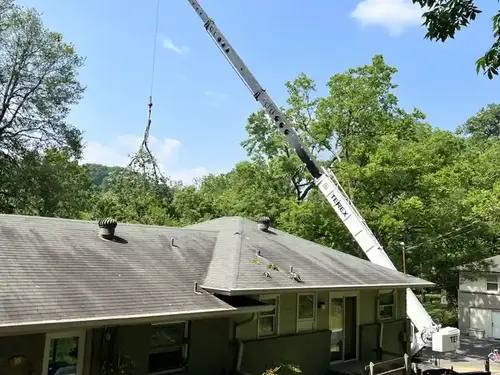
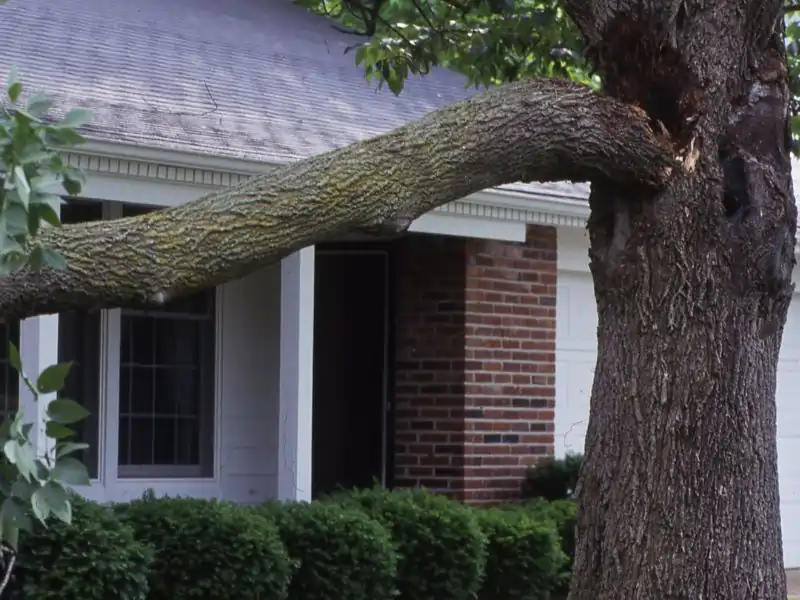
When the tree itself is salvageable but poses a hanging branch or widowmaker limb risk, targeted deadwood removal is often less costly than full tree removal. This type of limb removal is part of routine tree maintenance and can significantly extend a tree's safe life.
When multiple dead trees need to come down across a larger area, we coordinate the full scope – dead tree removal, wood chipping, debris hauling, and full site cleanup. Lot clearing and brush clearing jobs are priced transparently with upfront pricing so there are no surprises when the job is done.
Dead trees are disproportionately vulnerable during storm season. When severe weather hits Nashville, we handle both the downed debris and the hazardous standing remnant left behind – including fallen tree removal from roofs, fences, and across roadways where sidewalk and roadway obstructions need to be cleared safely.
Not sure whether your tree needs full removal or just targeted deadwood removal? Give us a call at 615-782-9966 and we'll walk you through the options.
Safe, transparent, and professional from first call to final cleanup
A professional arborist walks the site and evaluates structural integrity – decay, rot, hollow trunk, root system health, lean, and the presence of hanging branches or widowmaker limbs. We assess proximity to overhead power lines, structures, the public right-of-way, and any sidewalk obstructions.
Based on the risk assessment, we provide a free written estimate with upfront pricing. We explain the planned approach – whether that's straight felling, sectional removal, rigging and controlled lowering, crane removal, or bucket truck access – and establish an exclusion zone plan for jobsite safety.
Chainsaw work proceeds section by section, top-down. Rigging and controlled lowering keeps every piece in a planned drop zone. For large or awkward trees near structures or utility lines, we deploy crane or bucket truck equipment as needed. Dead wood is brittle; our crew accounts for that on every cut.
All wood, brush, and debris is hauled off-site. Wood chipping handles smaller material. Stump grinding (stump removal) is available as an add-on to grind the remaining stump below grade. The job isn't done until the site is clean and you're satisfied.
Experienced, honest, and fully covered – every dead tree removal job, every time
Owner Tanner Smith has worked in tree care since 2010. ISA-standard practices apply on every job, and a proper risk assessment is part of every site visit – not an afterthought.
Smith Works carries full general liability and workers' compensation insurance. A certificate of insurance is available before any work begins – so you're protected from day one.
We explain honestly what affects dead tree removal cost: tree height and diameter, access, proximity to structures, whether stump grinding is added, and debris volume. Cleanup is included in every job. The price you're quoted is the price you pay.
If a dead tree has caused damage to your property, we provide written documentation of the hazard and the work performed to support your homeowners' insurance claim – so you have what you need to file with confidence.
Our 4.9-star rating reflects consistent, professional service across Nashville neighborhoods including Green Hills, East Nashville, Sylvan Park, The Nations, 12 South, and communities throughout Middle Tennessee.
For trees that have already partially failed or present an immediate hazard – especially during storm season – emergency tree removal with rapid response is available. Call us anytime at 615-782-9966.
Dead tree removal cost varies based on the specifics of the job. Here's what we look at when building your free written estimate.
Larger trees require more crew time, more rigging, and more debris hauling. Taller trees may also need bucket truck access.
If equipment can't reach the tree directly, hand-carry or rope-rigging work increases time and cost.
Trees over roofs, near fences, or beside outbuildings require careful sectional removal and controlled lowering, which affects pricing.
Trees near overhead power lines may require utility coordination and specialized equipment, including crane removal or bucket truck access.
Large dead trees produce significant wood and brush volume. Wood chipping and debris hauling are included – the scope affects total time on site.
Stump removal (stump grinding) is available as an add-on and is priced separately so you can decide what makes sense for your property.
Free written estimate. Upfront pricing. Cleanup included in every job.
The price we quote is the price you pay. Call or submit a request below to get your estimate scheduled.
Common questions Nashville homeowners ask us about dead tree removal.
The scratch test is a good starting point: scratch a small patch of bark from a twig – green, moist cambium underneath means life; dry and brown suggests otherwise. But the full picture requires more than one twig. Signs like fungal conks at the base, mushrooms around the roots, widespread bark loss, a hollow-sounding trunk, or a canopy that never leafed out in spring are strong indicators of serious decline or death. A professional arborist can perform a proper tree hazard assessment to give you a definitive answer and recommend the right course of action.
Yes, in most cases. Dead wood is brittle and unpredictable – it can snap without warning, and loose or absent bark changes how climbing equipment and rigging behave. Structural integrity can't be assumed, which means sectional removal from the top down is often required even when a simple fell might otherwise be the approach for a healthy tree. Working with an experienced crew that accounts for these conditions on every cut is essential.
Coverage depends on your policy and circumstances. Most homeowners' insurance policies cover removal if a dead tree falls and causes damage to an insured structure – your home, a fence, or a vehicle. Removal of a standing dead tree that hasn't yet caused damage is typically not covered as a preventive measure. Smith Works provides written documentation of the hazard and the work performed to support any insurance claim you need to file.
Metro Nashville requires a Notification of Tree Removal permit for trees on private property that meet certain size thresholds (per nashville.gov). For trees that have already partially failed or present an immediate hazard, an Emergency Tree Authorization Form is available through the city. Whether your removal qualifies as an emergency or requires standard permitting depends on the tree's condition and size. Smith Works can advise on your specific situation before any work begins.
Dead tree removal cost depends on several factors: the tree's height and trunk diameter, access constraints (can our equipment reach it?), proximity to structures or overhead power lines, whether crane removal or a bucket truck is needed, debris volume, and whether stump grinding is added. Because dead wood requires more careful sectional removal and rigging, cost is often similar to or slightly higher than a comparable healthy tree removal. Smith Works provides free written estimates with upfront pricing – the price you're quoted is the price you pay, with full cleanup included.
We serve Nashville neighborhoods and communities across Middle Tennessee
If you have a dead, dying, or hazardous tree on your Nashville property, the right time to address it is before it fails on its own terms.
Call Smith Works or submit a request for a free written estimate with upfront pricing.
"I have used Smith Works for both tree removal and as arborists. For removal they dropped trees in tight places with precision and as arborists gave another 100 years to our 100 year old oak by cleaning it out, removing debris and allowing it to breathe. In both scenarios they protected gardens, fences, etc and did a great job of cleaning up. Excellent folks."